
Agentic AI in marketing is software that doesn’t wait for a prompt. You give it a goal, like “book more qualified discovery calls” or “keep cost per lead under $60,” and it plans the steps, uses your tools, checks the results and adjusts. Generative AI writes the email. An agent decides who gets it, sends it, watches what happens and tries something different tomorrow.
That’s a real shift, and it’s arriving faster than most marketing teams are ready for. Agentic AI is also the most over-hyped phrase in marketing right now.
This guide covers what agentic AI actually does today, where it fails, and six steps a small or mid-sized business can use to put it to work without betting the budget on it.
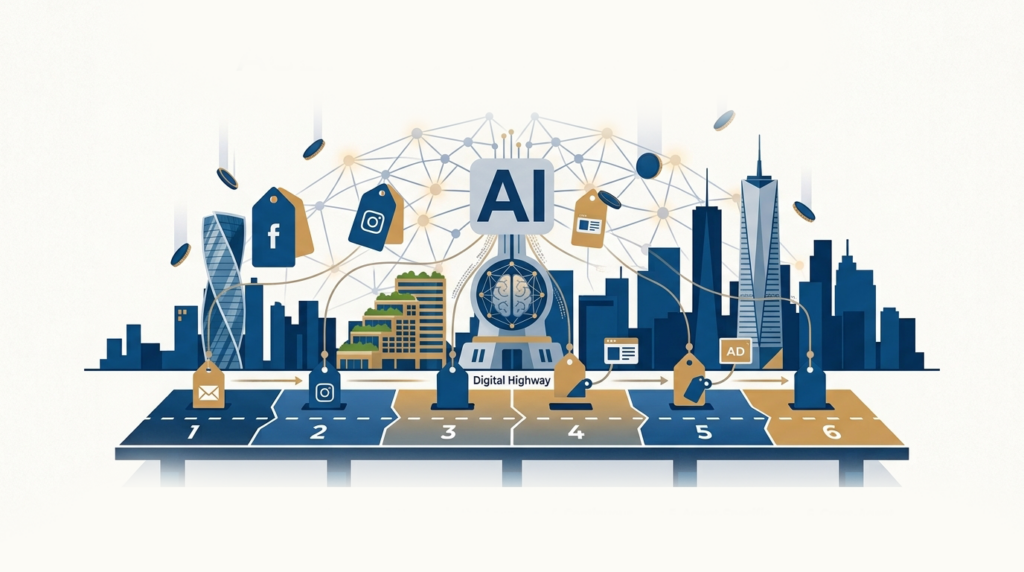
Table of Contents
What Is Agentic AI in Marketing?
Agentic AI is AI that works toward a goal with limited supervision. It reads your data, decides the next step, takes action inside your tools (ad platforms, CRM, email) and learns from what happens.
The easiest way to understand it is to compare it with the two tools most marketing teams already use.
| Marketing automation | Generative AI | Agentic AI | |
|---|---|---|---|
| How it starts | A trigger you set | A prompt you write | A goal you assign |
| What it does | Follows fixed rules | Creates content on request | Plans, acts, checks, adjusts |
| When things change | Keeps following the old rule | Waits for your next prompt | Changes course |
| Your role | Build the workflow | Review the output | Set the goal and the guardrails |
Traditional automation is a set of if-then rules. It’s reliable, but rigid: when a customer does something you didn’t plan for, the workflow keeps running the old instructions. Generative AI is creative but passive. It produces a draft, then waits for you. Agentic AI closes the loop between the two. It can create, act, measure and try again.
Agentic AI vs. “agentwashing”
A warning before you shop: a lot of what’s sold as an agent isn’t one. Gartner says the most common misconception is calling AI assistants agents, a confusion it blames on widespread “agentwashing.” Assistants simplify tasks, but they still depend on human input.
A simple test: if the tool can’t take an action in another system without you approving every single step, it’s an assistant. That’s still useful. It just isn’t agentic AI.
Where Agentic AI Is Already Doing Real Marketing Work
The strongest agentic AI use cases today are narrow, repetitive and measurable. Agents aren’t running whole marketing departments. They’re taking over specific jobs that follow a pattern and produce a number you can track.
Paid media pacing and optimization
An agent monitors spend across campaigns, shifts budget toward ad sets that are converting, pauses creative that’s fatiguing and flags anomalies before they burn a week of budget. The guardrail here is non-negotiable: hard spending caps it can’t cross.
This is where agentic AI tends to prove itself fastest, because the feedback loop is short. Spend goes out, results come back within hours, and the agent can adjust the same day instead of waiting for a weekly review.
Lead follow-up and nurturing
A form comes in at 9:40 p.m. The agent responds within minutes, asks qualifying questions, books a call on your calendar and updates the CRM. For lead-driven businesses, speed to lead is often where the money is hiding.
It also handles the follow-up that humans forget. The prospect who went quiet after a proposal gets a thoughtful check-in on day three and day ten, not a generic blast three weeks later.
Content operations
The agent turns one approved piece into versions for each channel, drafts briefs and checks copy against your brand rules. A human still approves before anything goes live. We covered the groundwork for this in AI Automation: The Benefits of Automating Blogs, Newsletters, and Emails.
Reporting and insight
Instead of someone spending Monday morning exporting spreadsheets, an agent pulls platform data, reconciles the numbers and writes the “what changed and why” summary. Your team starts the week with decisions, not data entry.
Research and competitor monitoring
Agents can watch competitor ads, review sites and search results, then surface what changed. You find out a competitor dropped their pricing before your sales team hears about it on a call.
The Agentic AI Hype Gap: What the 2026 Data Says
Most companies talk like they’ve gone agentic. Far fewer have.
BCG’s 2026 survey of 300 global CMOs found that 96% say AI is driving end-to-end transformation of their marketing function, yet only about a third have actually done the work. 42% still use generative AI only to help people with individual tasks, just under a third have moved to agent-led workflows, and only 8% run campaigns where multiple agents operate on their own.
Meanwhile, agentic AI is coming whether you plan for it or not. Gartner predicts 40% of enterprise applications will include task-specific AI agents by the end of 2026, up from less than 5% in 2025. The CRM, ad platform and email tool you already pay for are adding agent features right now.
But there’s a catch. Gartner also predicts that more than 40% of agentic AI projects will be cancelled by the end of 2027, because of escalating costs, unclear business value or weak risk controls.
Both things are true at once. Your tools will get agents automatically. Your results will depend entirely on what you point them at.
Why Agentic AI Projects Fail: They Amplify What You Already Have
An agent is a multiplier. Point it at a clear strategy, clean data and a documented process, and the results compound. Point it at a messy CRM and fuzzy goals, and agentic AI scales the mess at machine speed.
- No defined goal. “Use AI” isn’t a goal. “Cut lead response time to under 10 minutes” is.
- Dirty data. If your tracking counts page views as conversions, a budget agent will happily buy you more page views. It optimizes to whatever signal you give it, right or wrong.
- No guardrails. Nobody decided what the agent can do alone, what needs approval, or what it should never do.
- Measuring the wrong thing. Hours saved feels good. Qualified leads and revenue pay the bills.
- Automating a broken process. If the manual version doesn’t work, the automated version fails faster.
None of these are technology problems. They’re strategy problems, which is good news: you can fix them before you spend a dollar on agentic AI software.
Agentic AI Is Also Changing How Customers Find You
Your next customer may send an AI to shortlist vendors before they ever visit your website. That’s the other half of agentic AI in marketing, and most businesses are ignoring it.
In BCG’s 2026 survey, 90% of CMOs agreed that generative AI is already reshaping how consumers discover and evaluate brands, and a majority said they’re setting up dedicated AEO and generative engine optimization teams.
For a business in Toronto or the GTA, that means the basics matter more than ever:
- Clear answers to the questions buyers actually ask, near the top of the page.
- Consistent facts about your services, pricing ranges and service area across your site, Google Business Profile and directories.
- Real, recent reviews that mention what you do.
- Pages built so an AI can read and quote them: descriptive headings, short answers and structured data.
If an agent can’t work out what you do and where you do it, you’re not on the shortlist. Our digital marketing services team builds this into every site we manage.
How to Start With Agentic AI: 6 Proven Steps
Start with one workflow, one metric and one set of guardrails. Here’s the 30-day sequence we recommend.
1. Pick one workflow (week 1)
Choose something repetitive, rules-heavy, measurable and low-risk if it goes sideways. Lead follow-up and weekly reporting are usually the best first candidates for agentic AI.
2. Document how your best person does it (week 1)
Write down the steps, the decisions and the exceptions. If you can’t document it, an agent can’t do it. This step alone often exposes wasted effort you can cut today.
3. Clean the inputs (week 2)
Fix your tracking, de-duplicate the CRM and agree on what actually counts as a conversion. Agentic AI is only as good as the signals you feed it.
4. Set the leash (week 2)
Decide what the agent handles alone, what needs a human’s approval, and the hard limits: budget caps, messages per contact, topics it never touches and words it never uses.
5. Run it alongside a human (weeks 3 and 4)
Compare the agent’s results with your baseline on one business metric, such as response time, cost per qualified lead or hours saved on reporting. Count setup and oversight time as a cost.
6. Keep it, fix it or kill it (day 30)
If the numbers are better, give the agent a little more room. If not, fix the inputs or retire it. Then pick the next workflow. Small, boring and measurable beats big and impressive every time.
Human-Led, Agent-Powered: How We Use Agentic AI
Our position at Social Know How is simple: AI enhances, humans lead. Agents are excellent at the doing. People still own the strategy, the brand judgment and the client relationships, and every AI output gets reviewed by a person before it reaches a customer.
The businesses that win with agentic AI won’t be the ones that buy the most tools. They’ll be the ones that did the strategy and planning first, so their agents had something worth amplifying.
If you want help picking your first workflow, cleaning up the data behind it and setting guardrails that protect your brand, that’s the work our fractional CMO consulting team does. Book a discovery call and we’ll map where an agent would actually pay off in your business.
Agentic AI FAQs
What’s the difference between agentic AI and generative AI?
Generative AI creates content when you ask for it: an email, an image, an ad headline. Agentic AI works toward a goal. It decides what to do, takes action in your tools, checks the result and adjusts without being prompted each time.
Will AI agents replace marketing teams?
They’re changing teams more than replacing them. BCG found the CMOs leading this shift run smaller, AI-enabled teams with broader remits, and about 80% of CMOs are making significant investments in AI upskilling. The execution work shrinks. The strategy and judgment work grows.
Is agentic AI only for big companies?
No. Agent features are being built into the CRM, ad and email platforms small businesses already use. Starting with one well-defined workflow keeps the cost and risk modest.
How do I measure the ROI of an AI agent?
Pick one business metric before you start, record your human baseline, then compare after 30 days. Include setup and oversight time in the cost, not just the software fee.
Is agentic AI safe for my brand?
It can be, with guardrails. Give the agent approved messaging, a list of things it must never say or promise, spending limits and a clear rule for when to hand off to a person. Review its work weekly for the first few months.
How long does it take to see results from agentic AI?
For a narrow workflow like lead follow-up or reporting, you’ll usually know within 30 days whether it’s working. Broader, multi-agent setups take longer, because the data and process work comes first.